

October 22, 2026 · 2 min read
Technology for Higher Education: Six Pillars of the Digital Campus Ecosystem
A university runs many processes at once: admitting new students, managing courses and grading, measuring graduate outcomes, and reporting to PDDikti. Problems start when each process lives in a different system or spreadsheet and the same data is entered again and again.
An ecosystem, not just an application
One application can solve one process. But a campus works as a sequence: applicants become students, students take courses, their grades become learning outcomes, and everything is reported. When data moves from one stage to the next without being entered again, staff do less repetitive work and the data is more trustworthy.
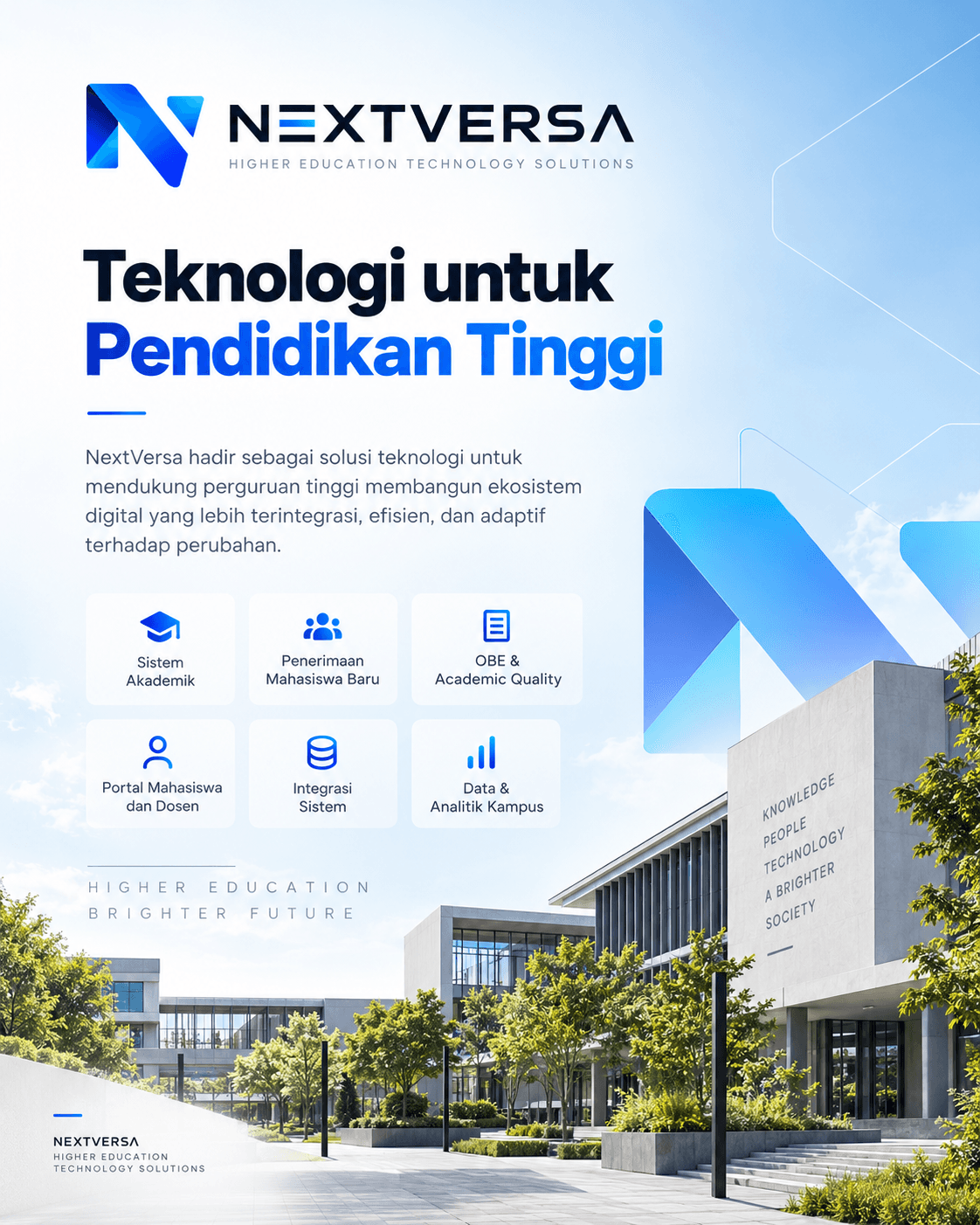
That is how NEXTVERSA sees higher education technology: a connected ecosystem built around how a campus actually works. Here are its six pillars.
1. Academic system
The operational core of a campus: student and lecturer records, online course planning (KRS), class and exam schedules, attendance, grades and transcripts, theses, and graduation. At NEXTVERSA, this pillar is delivered through SIAKAD.
2. Admissions (PMB)
Registration and selection are where student data begins. The online admissions portal handles intake waves, quotas, and fees, plus a verification and selection queue. Because admissions is part of the same SIAKAD, applicant data does not have to be moved by hand into another system.
3. OBE and academic quality
Outcome-Based Education (OBE) organizes teaching around graduate learning outcomes (CPL), broken down into CPMK and Sub-CPMK. Grades from SIAKAD can be read by the OBE system to calculate CPL attainment, which then feeds a continuous quality improvement (CQI) cycle.
4. Student and lecturer portals
Students plan courses and see schedules and grades; lecturers manage classes, attendance, grades, advising, and syllabi. The portals become one front door to academic services, so routine matters no longer depend on queues at the academic office.
5. System integration
A campus doesn't work alone: there is PDDikti reporting and other systems already in place. SIAKAD connects to PDDikti Neo Feeder, and grades and academic data can be synchronized to other systems through REST or CSV import.
6. Data and reporting
When data is kept in one place, summaries and reports become easier: dashboards of students by program and status on the academic side, outcome evaluation per program, faculty, and institution on the OBE side, and Excel and PDF export.
Start from the process, not the application
Not every campus needs to build everything at once. A sensible path: map the processes, find where the most time is lost, then build in stages while keeping data connected. NEXTVERSA works that way — understanding the academic workflow first, then designing the system.
Contact
Have a project in mind?
Tell us what you're trying to build. We'll help turn the idea into a practical digital solution.
A good first message includes
- 01What you want to build, or the problem to solve
- 02Who will use it
- 03Your timeline and any existing system