

Outcome-Based Education — OBE
An Outcome-Based Education platform for universities that turns SIAKAD grades into graduate learning outcome (CPL) attainment, then closes the continuous quality improvement (CQI) loop.
- Type
- Outcome-Based Education
- Scope
- OBE curriculum & syllabus (RPS) · SIAKAD integration · CPL attainment calculation · Immutable evaluation · CQI cycle & reports
- Stack
- Next.js · NestJS · PostgreSQL · Prisma
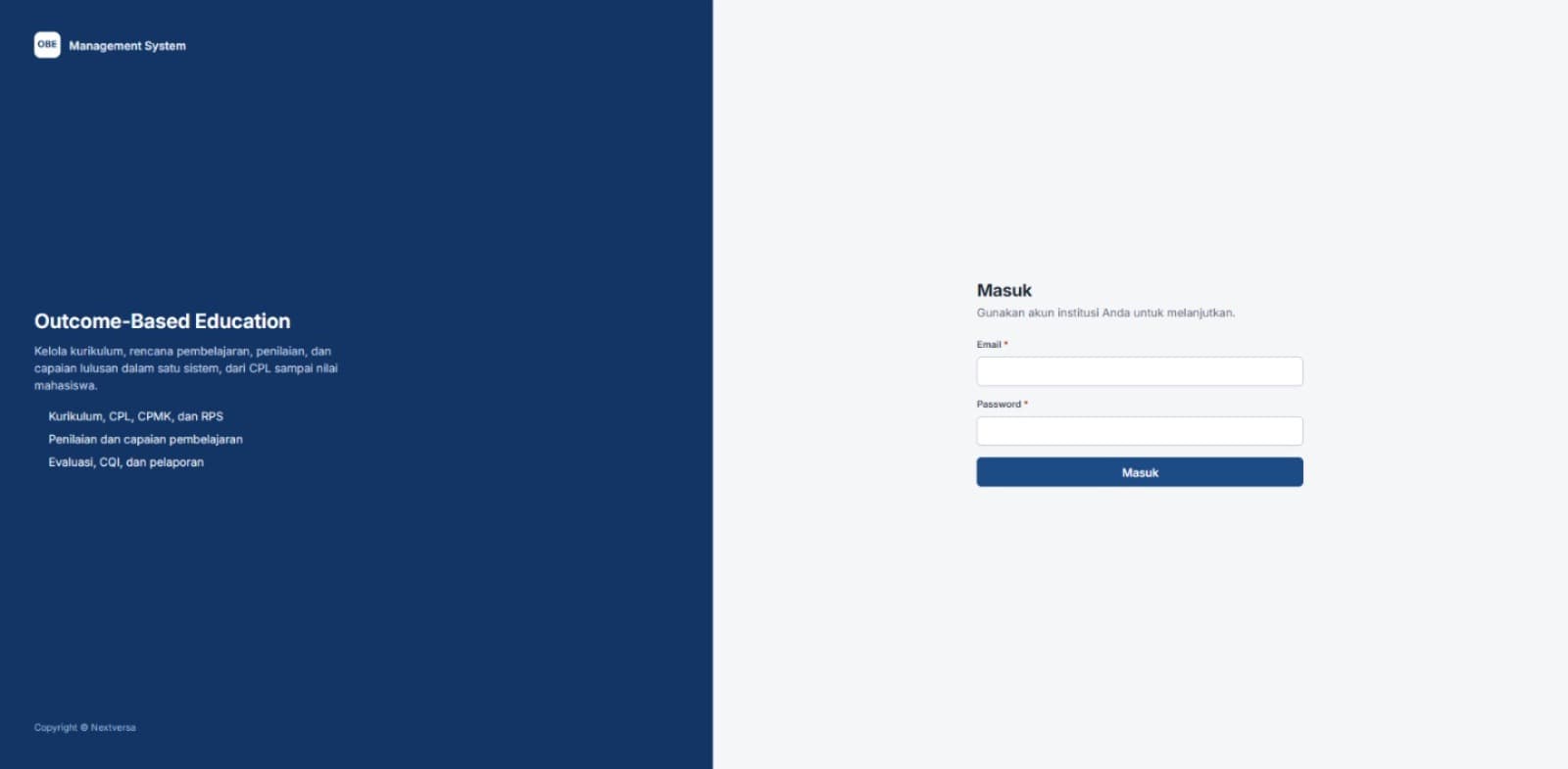
01OBE
Overview
OBE involves many layers — the curriculum, the syllabus of every course, the grades students earn, and the evaluation that follows — and each has to stay consistent across academic periods.
The OBE Management System brings them into one platform: curriculum and RPS on one side, SIAKAD grades on the other, and an attainment engine in between that feeds evaluation, CQI, and reports.
02OBE
Why we built it
Grades alone don't show whether graduates achieved the outcomes a program promised.
Campuses are asked to show attainment of graduate learning outcomes, yet grades usually live in the academic system while OBE documents live in spreadsheets, so the two rarely meet.
The OBE Management System connects them: grades flow in from SIAKAD, are mapped to outcomes, and become evaluation results that stay fixed — so improvement efforts can be tracked against evidence rather than memory.
03OBE
What the system covers
- 01
Curriculum & OBE structure
Institution → Faculty → Program → Curriculum, graduate profiles, CPL, CPMK, and Sub-CPMK with weighted CPMK → CPL mapping.
- 02
Syllabus (RPS)
Meetings, study materials, methods, assessments, and rubrics, with a review, publish, and revise flow, one RPS per course per period.
- 03
SIAKAD integration
REST sync of students, lecturers, courses, classes, KRS, and grades with a log per source, plus CSV import as a fallback.
- 04
Grade component mapping
RPS defaults with per-class overrides, weights validated to exactly 100%, and manual scores that sync never overwrites.
- 05
Attainment calculation
Assessment → Sub-CPMK → CPMK → CPL with weighting, missing-data handling, and evidence coverage.
- 06
Evaluation dashboard
Program, faculty, and institution views with drill-down to the assessment, and immutable per-period results.
- 07
CQI cycle
Findings, root causes, plans, actions, and re-evaluation across periods.
- 08
OBE reports
PDF and Excel reports covering gaps, contributors, plans, and re-evaluation results.
- 09
Access & security
Super Admin, Faculty Admin, Program Admin, and Lecturer roles with tiered scope and secure sessions.
04OBE
Features by role
One system with four access roles in tiers — from the Super Admin who runs the institution to the lecturer who only sees the classes they teach.
- access roles with tiered scope
- 4access roles with tiered scope
- levels from assessment to CPL
- 4levels from assessment to CPL
- weight check per Sub-CPMK
- 100%weight check per Sub-CPMK
- automated tests
- 680+automated tests
01Super Admin
Institution-wide view and control4 features
Sets up the institution structure and keeps data flowing from SIAKAD, with visibility across every faculty and program.
Institution structure
Institution → Faculty → Program → Curriculum hierarchy, the foundation every other record hangs from.
Users & roles
Manage accounts and assign Faculty Admin, Program Admin, and Lecturer roles with tiered scope.
SIAKAD synchronization
Sync students, lecturers, courses, classes, KRS, and grades over REST, with a log per source and CSV import as a fallback.
Institution evaluation dashboard
Attainment across the whole institution, with drill-down to faculty, program, and down to the assessment.
02Faculty Admin
Oversight across the faculty's programs3 features
Follows outcome attainment for every program in the faculty and reports on it.
Faculty evaluation dashboard
Compare programs, find gaps, and drill down to the contributing courses and assessments.
CQI follow-up
See findings, plans, and re-evaluation results for programs in the faculty.
OBE reports
PDF and Excel reports that answer gaps, contributors, plans, and re-evaluation results.
03Program Admin
Curriculum, outcomes, and continuous improvement7 features
The program's workspace for defining what graduates should achieve and tracking whether they do.
Graduate profile, CPL, CPMK & Sub-CPMK
Define graduate profiles and the outcome hierarchy, with weighted CPMK → CPL mapping.
Syllabus (RPS) review & publishing
Review, publish, and revise RPS documents — meetings, study materials, methods, assessments, and rubrics.
Period-bound RPS
One RPS per course per academic period; creating a new period's RPS never changes older results.
Grade component mapping
Default mapping in the RPS, validated so Sub-CPMK weights total exactly 100%.
Program evaluation
Per-period evaluation with drill-down to the assessment to look for likely causes.
CQI cycle
Findings, root causes, plans (owner, indicator, target period), actions, and re-evaluation across periods.
OBE reports
PDF and Excel reports for accreditation and internal quality review.
04Lecturer
Your classes, your scores, your attainment5 features
Lecturers see and manage only the classes they teach, with team teaching supported.
Own classes only
Access is limited to classes the lecturer teaches; team teaching is supported.
Per-class component mapping
Override the RPS default when a class names its grade components differently.
Manual scores
Enter or adjust scores by hand; synchronization never overwrites a manual score.
Class attainment preview
Read-only preview of attainment from the SIAKAD snapshot, using the same engine as the final evaluation.
Syllabus (RPS) drafting
Prepare the RPS for the courses they teach and send it through review.
What ties it together
Design decisions that keep the numbers trustworthy and auditable.
Immutable evaluation results
Per-period evaluation results cannot be changed, enforced at the database level.
History is preserved
Grade snapshots are immutable, each RPS belongs to one period, and enrollment and scores are kept per class and period.
Repeaters keep their history
A student retaking a course does not overwrite earlier attempts, and Class A scores never mix with Class B.
No guessing
Grade components are never mapped by name similarity; uncertain legacy data is left alone and reported.
Evidence coverage
Attainment comes with how much evidence supports it, handling missing data so numbers don't mislead.
No automatic cause and effect
Re-evaluation between periods shows what changed without claiming the action caused it.
Secure sessions
JWT with rotating refresh tokens in HttpOnly cookies, and role scope enforced on the server.
Safe migrations
Non-destructive Prisma migrations with conflict checks, and an audit-first, stage-by-stage rollout.
Automated testing and delivery
Over 680 automated tests (unit and end-to-end), with CI/CD that builds and deploys container images.
05OBE
Architecture
A TypeScript monorepo with a separate web interface and API, and a relational database that preserves history for every academic period.
- Next.js
- Web interface for every role, built with React and TypeScript.
- NestJS
- API and the OBE attainment, evaluation, and CQI logic.
- PostgreSQL
- Relational database that keeps history and enforces immutable results.
- Prisma
- Typed data access and safe, non-destructive migrations.
06OBE
Frequently asked questions
- What is OBE (Outcome-Based Education)?
- OBE organizes teaching around what graduates should be able to do. Graduate learning outcomes (CPL) are broken down into course outcomes (CPMK) and Sub-CPMK, assessed in each course, and the results are used to improve the curriculum.
- Does the OBE Management System replace SIAKAD?
- No. It reads grades and academic data from your SIAKAD over REST (with CSV import as a fallback) and turns them into OBE attainment. SIAKAD keeps running the academic administration.
- How is CPL attainment calculated?
- Attainment is computed along the chain Assessment → Sub-CPMK → CPMK → CPL, using weights and a clear rule for missing data, and shows how much evidence backs each figure.
- Can evaluation results be changed afterwards?
- No. Once a period's evaluation is produced, it cannot be edited — this is enforced in the database — so results stay auditable and comparable between periods.
- What is the CQI cycle?
- Continuous quality improvement: record findings and root causes, make a plan with an owner, indicator, and target period, carry out actions, then re-evaluate in a later period.
- How much does it cost, and can we try a demo?
- Contact us on WhatsApp at 0812-7643-8553 and tell us about your campus; we'll arrange a demo and pricing.
Pricing & demo
Interested in the OBE Management System for your campus?
For pricing information and a demo, contact us on WhatsApp.
WhatsApp · 0812-7643-8553